1. Market Demands Are Changing. Can Your Product Line Capture More Sales Opportunities?
For electric scooter importers, expanding a product line is an important way to reach more customer segments and create new sales opportunities. However, this often comes with three practical challenges:
- Limited best-selling models: Relying heavily on a few popular models can restrict market coverage and limit further sales growth.
- Diverse customer preferences: Existing models may not fully meet different expectations for design, performance, pricing, and features, potentially leaving sales opportunities untapped.
- Growing operational pressure: Adding new models often means additional development costs, purchasing arrangements, vehicle inventory, and after-sales spare parts management.
The challenge is not simply how to introduce more models, but how to expand a product line efficiently.
How can importers offer more product choices while keeping development costs and inventory pressure under control?
2. Shared Product Platforms: Reduce Repeated Development and Expand More Efficiently
Expanding a product line does not necessarily mean developing an entirely new vehicle every time.
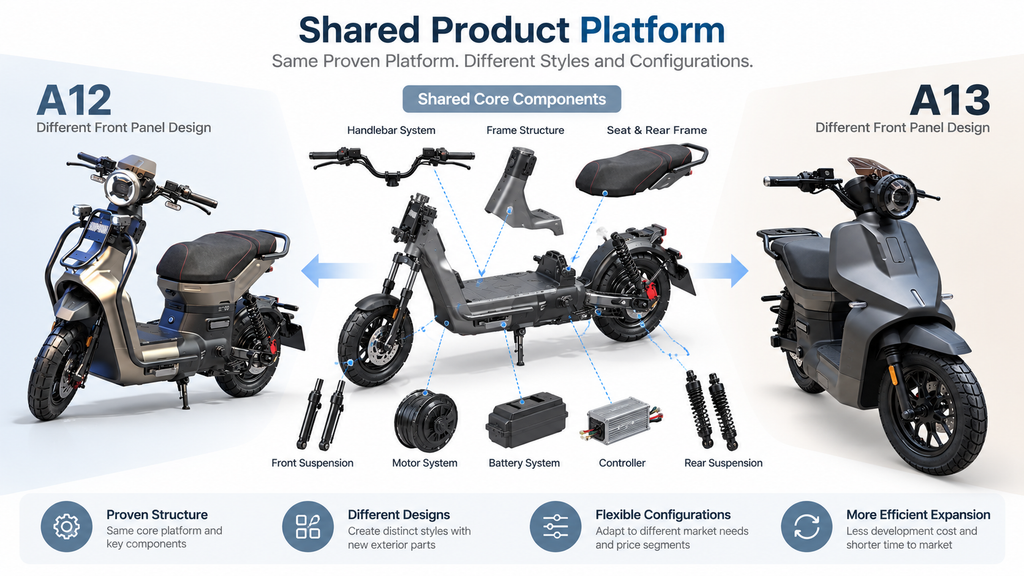
A Shared Product Platform offers a different approach. By retaining proven frames, core structures, and compatible technical components, manufacturers can develop additional product versions by modifying selected exterior parts or configurations.
This approach offers four key advantages:
- Less repeated development: Reusing established structures and technical solutions can reduce the time and investment required for new product versions.
- Greater parts commonality: Sharing core components across different models helps simplify purchasing and supply chain management.
- Lower spare parts complexity: Common components can support multiple models, reducing the need to stock additional model-specific replacement parts.
- More room for product adjustments: Exterior designs and technical configurations can be adapted to changing market preferences without redesigning the entire vehicle.
The principle is straightforward: Keep what is proven and shareable, and focus development efforts on what genuinely needs to change.
For importers, this creates a more efficient way to expand product choices while managing development costs, parts inventory, and after-sales requirements.
3. One Proven Platform, More Product Choices and Sales Opportunities
For importers, the purpose of adding models is not simply to increase the number of products in a catalog. It is to serve different customer needs and create more opportunities in the market.
Even within the same market, consumers may have different preferences for styling, motor performance, battery options, and price. Developing a completely independent vehicle for every customer segment can quickly increase costs and operational complexity.
A shared product platform allows manufacturers to expand product choices in two ways.
Different Designs for Different Customer Preferences
By retaining the same proven frame and core structure while modifying selected exterior components, manufacturers can create different styling options for customers with different design preferences.
Different Configurations for Different Market Requirements
Within the technical capabilities of the platform, manufacturers can offer different motor power, wheel size, and battery options to suit various riding conditions, customer expectations, and price segments.
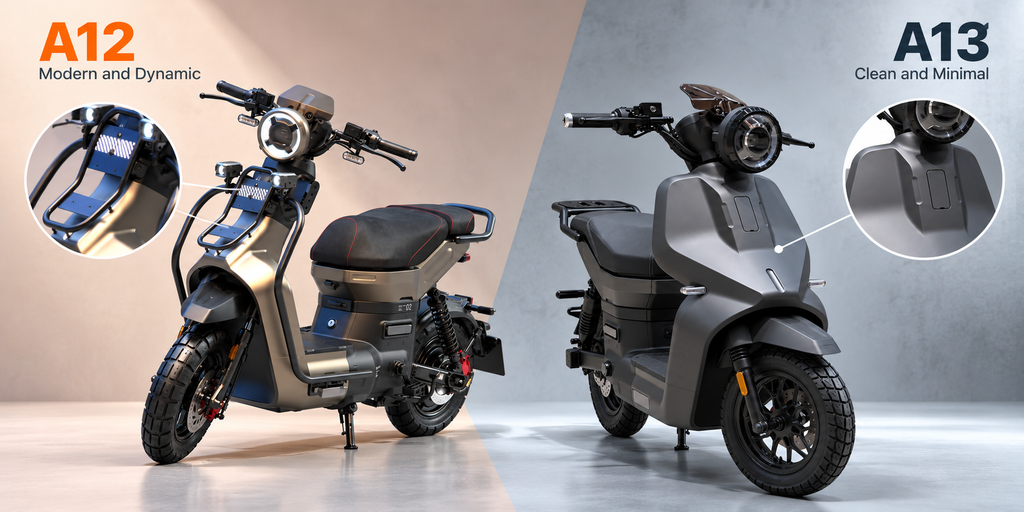
For example, Dynomove’s A12 and A13 are developed on a shared product platform. Different front panel designs give the two models distinct appearances, while the product range also offers different technical configuration options.
| Configuration | Available Options |
|---|---|
| Motor Power | 1000W / 1200W / 1500W |
| Wheel Size | 10-inch / 12-inch |
| Battery Configuration | Single Battery / Dual Battery |
Available configurations depend on the specific model and technical requirements. Not all options can necessarily be combined.
For importers, this approach makes it possible to build a broader product range from a more focused development foundation.
More product choices can help reach different customer segments without requiring a completely independent vehicle platform for every variation.
4. Replaceable Design: Adjust Existing Inventory Based on Market Feedback
Importers usually need to decide which models to purchase and how many units to order before actual market demand becomes fully clear.
However, customer preferences are often better understood after products enter the market. One design may sell more slowly than expected, while another attracts stronger interest.
For vehicles that have already been manufactured and shipped overseas, changing the inventory mix can be difficult.
Keep More Flexibility in Existing Vehicle Inventory
When different product versions use a small number of interchangeable components, importers may be able to adjust part of their existing inventory without purchasing additional complete vehicles.
Dynomove’s A12 and A13 provide a practical example.
When equipped with the same technical configuration, the only difference between the A12 and A13 is the front plastic panel. All other components are shared.
This means that even after an A12 has been fully assembled, packaged, and shipped overseas, its appearance can be changed to the A13 design by replacing the front panel.
A Practical Inventory Adjustment Example
Suppose an importer has 100 units of the A12 in stock. After introducing the product to the market, the importer discovers that some customers prefer the appearance of the A13.
Instead of ordering another batch of complete vehicles, the importer could purchase 50 sets of A13 front panels and convert 50 existing A12 units to the A13 appearance.
| Inventory | A12 | A13 | Total Vehicles |
|---|---|---|---|
| Before Adjustment | 100 | 0 | 100 |
| After Adjustment | 50 | 50 | 100 |
This is a hypothetical example illustrating the inventory adjustment process.
The importer now has two styling options available for sale, while the total number of complete vehicles remains unchanged.
The adjustment still involves purchasing replacement panels, labor, handling the original panels, and necessary inspections. Local homologation, registration, or labeling requirements may also need to be considered.
Nevertheless, this approach provides an alternative to purchasing additional complete vehicles simply to introduce another styling option.
The real value of replaceable design is not just offering different appearances. It is preserving some flexibility to adjust the product mix even after vehicles have been purchased and delivered.
For importers, this can reduce dependence on perfectly predicting customer preferences before placing an order.
5. Greater Parts Commonality, Less After-Sales Inventory Complexity
Expanding a product line also means taking responsibility for after-sales support across more models.
Different vehicles may require different motors, controllers, frame components, body panels, and replacement parts. As the number of models increases, spare parts purchasing, inventory management, technical support, and long-term parts availability can become more complicated.
More Models Do Not Always Require More Types of Spare Parts
A shared product platform can reduce this complexity by increasing the number of components used across multiple product versions.
Instead of maintaining a completely separate spare parts inventory for every model, importers can manage shared components across compatible versions and stock additional parts only where differences exist.
For example, when the A12 and A13 have identical technical configurations, all components except the front panel are interchangeable.
Introducing an additional styling version therefore does not require a completely separate after-sales parts system.
| Independent Vehicle Models | Shared Platform Models |
|---|---|
| Different models may require different core spare parts. | Multiple versions can share compatible core components. |
| New models may introduce more model-specific parts. | Additional parts are mainly required for components that differ. |
| More separate parts need to be managed. | Common components can be managed together. |
Actual parts compatibility depends on the model and technical configuration. Different motor or electrical configurations may still require dedicated components.
For importers, the number of different spare parts required to support a growing product line can matter as much as the number of models offered.
Greater parts commonality can help reduce duplicate stocking, simplify purchasing, and keep after-sales operations manageable as the product range expands.
6. Build a Product Line That Can Continue to Evolve
For importers, product line planning is not a one-time purchasing decision.
Consumer preferences change. Competition evolves. Demand for different performance levels, features, and price points may also shift over time.
Beyond choosing products that are suitable for today’s market, importers need to consider another question: Can the existing product range support future adjustments?
When every new model requires a completely independent vehicle platform, importers may need to establish new parts inventories, learn different technical structures, and take on additional purchasing and management requirements.
A shared product platform provides a foundation for more flexible product planning.
From Individual Model Purchases to Long-Term Product Planning
The benefits of a shared platform can extend across different stages of an importer’s business:
| Business Stage | Value of a Shared Product Platform |
|---|---|
| Product Development | Reduce repeated development by using proven structures. |
| Market Expansion | Offer different designs and configurations for more customer segments. |
| Inventory Management | Adjust certain existing vehicles based on market feedback. |
| After-Sales Support | Share compatible components and simplify spare parts management. |
| Long-Term Planning | Develop additional product versions from an established platform. |
A shared platform cannot accommodate every market requirement, nor does it eliminate the need for further engineering, testing, or regulatory compliance.
However, for products with similar structural and technical requirements, it can provide a practical foundation for future development while reducing some of the repeated investment associated with introducing new models.
A competitive product line is not defined only by how many models an importer offers today, but also by how efficiently that product line can adapt and expand tomorrow.
At Dynomove, we apply the shared platform approach to product development, combining proven vehicle structures, flexible product variations, and high parts commonality to support our partners’ product range development and long-term business needs.
Explore Dynomove’s Electric Scooter Range
Discover our electric scooter models and available configurations, and discuss how our shared product platforms can support your market requirements and future product line planning.