Introduction
Choosing an electric scooter manufacturer is not simply a matter of finding the lowest quotation.
For importers, distributors, dealers, and mobility brands, the supplier you choose will affect product quality, order cost, delivery time, spare parts, and your ability to support the product after it enters the market.
If you are sourcing electric scooters from China for the first time, the process can be difficult because different suppliers may quote different specifications, configurations, and commercial terms.
This guide provides a practical process you can use to compare manufacturers before placing a bulk order.
The basic process is:
Define your requirements → Shortlist suppliers → Compare specifications → Test samples → Check production → Confirm commercial terms → Place the bulk order
Step 1 — Define Your Market and Product Requirements
Before contacting manufacturers, define what you actually need.
You do not need to have every specification finalized, but you should have enough information for suppliers to quote comparable products.
Start with:
- Target country or region
- Customer type
- Target price segment
- Main usage scenario
- Expected motor power
- Battery type and capacity
- Wheel size
- Target order quantity
- Required certifications or market requirements
Example: Prepare a Simple RFQ
For example, an importer targeting urban commuters may need a practical 1200W–1500W scooter with a choice of lead-acid or lithium battery.
Another buyer may be targeting a more price-sensitive market and may prioritize a lower purchase cost over higher specifications.
These two buyers should not necessarily receive the same product recommendation.
Practical Tip
Prepare a simple RFQ before contacting suppliers.
Target market: Colombia
Customer type: Urban commuters
Product position: Mid-range
Motor: 1200W–1500W
Battery: Lead-acid / lithium options
Initial order: 1 × 40HQ
This gives suppliers a clear basis for quotation and makes their offers easier to compare.
Step 2 — Build a Shortlist of 3–5 Suppliers
Do not make your purchasing decision based on the first supplier who replies.
A practical approach is to shortlist around three to five manufacturers and ask them to quote against the same requirements.
Create a simple comparison table:
| Item | Supplier A | Supplier B | Supplier C |
| Product match | ✓ | ✓ | ✓ |
| Motor | 1200W | 1500W | 1200W |
| Battery | 60V 20Ah | 72V 20Ah | 60V 20Ah |
| MOQ | |||
| Lead Time | |||
| OEM options | |||
| Warranty | |||
| Spare Parts |
Watch for This
If Supplier A quotes USD 500 and Supplier B quotes USD 560, the difference may look significant.
But if Supplier A’s price excludes the battery, charger, or a required configuration, the comparison is meaningless.
Always compare like with like.
Step 3 — Compare the Complete Specification
Once you have shortlisted suppliers, ask each supplier for a complete specification sheet.
Do not compare products based only on motor power or battery capacity.
Check the complete configuration, including:
- Dimensions
- Wheel size
- Motor power
- Battery type and capacity
- Maximum speed
- Payload
- Net weight
- Starting system
- Controller
- Charger
- Lighting
- Available options
Example
For example, two scooters may both be described as “1200W electric scooters,” but their battery systems, wheel sizes, payload, controller, and other specifications may be completely different. You can compare different configurations in the Smart A Series.
Practical Rule
Create one standard specification sheet and ask every supplier to fill it in.
This makes it much easier to identify differences that are hidden inside a quotation.
Step 4 — Order a Sample Before the Bulk Order
Never rely entirely on photos, videos, or specification sheets.
A sample allows you to check whether the actual product matches the quotation.
Basic Sample Inspection
Appearance
- Paint and surface finish
- Plastic parts
- Panel gaps
- Labels and markings
Mechanical
- Frame
- Brakes
- Suspension
- Wheels and tires
- Stand
Electrical
- Lights
- Display
- Starting system
- Acceleration
- Charging
- Battery connection
Practical Riding
- Acceleration response
- Braking
- Steering
- Stability
- Noise or abnormal vibration
Example
If a supplier’s quotation specifies one battery capacity but the sample arrives with a different configuration, resolve the difference before discussing the bulk order.
Do not assume that the factory will automatically correct it later.
Step 5 — Check How the Manufacturer Controls Quality
After evaluating the sample, look at how the manufacturer manages quality control during production.
Ask specific questions instead of simply asking: “Do you have quality control?”
A better approach is to ask:
- How are incoming components checked?
- How is the frame inspected?
- What is checked during assembly?
- Are electrical functions tested?
- Is every finished vehicle inspected?
- How is packaging checked before loading?
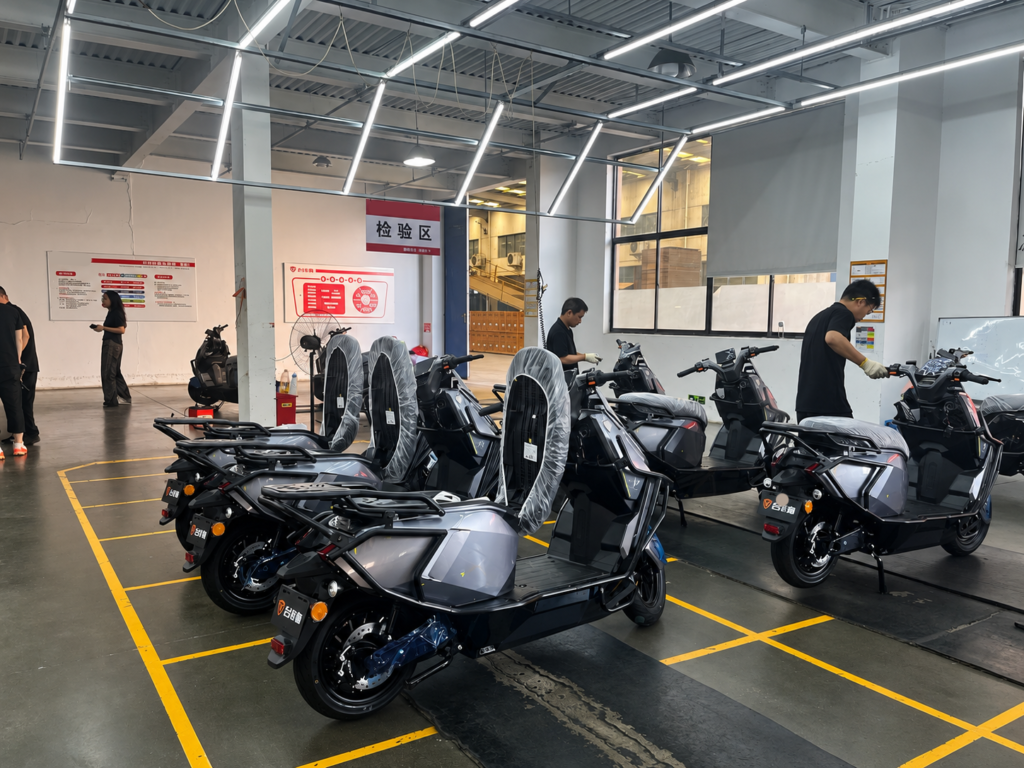
If possible, ask to see the actual production and inspection process.
Why This Matters
A sample can be good while mass production is inconsistent.
For example, if the supplier changes components between the sample and the production batch without confirmation, the final product may no longer match the product you approved.
For this reason, the approved sample and confirmed specification should become the reference for the bulk order.
Step 6 — Confirm Production Capacity and Lead Time
Before placing an order, confirm how long production will actually take.
“What is your lead time?” Ask more specifically:
“What is the production lead time for this model and this order quantity?”
Then clarify:
- MOQ
- Production capacity
- Component availability
- Battery availability
- Packaging time
- Loading schedule
- Estimated shipment date
Example
A supplier may tell you: Sample: 7 days Production: 30 days
That sounds straightforward, but you should still ask whether the 30 days starts after receiving the deposit and finalizing all specifications.
You should also ask whether the battery and other key components are already available.
A production lead time is only useful when the starting point and conditions are clearly defined.
Step 7 — Confirm Export and Shipping Arrangements
For international buyers, production is only one part of the process.
Before ordering, confirm:
- Export port
- Packaging method
- Container loading
- Export documentation
- Commercial invoice
- Packing list
- Bill of lading
- Shipping arrangements
- Responsibility for export procedures
This is particularly important for new importers.
Example
If the supplier normally ships from one port but your forwarder uses another port, confirm the additional inland transportation cost before signing the order.
The product price should never be evaluated separately from the logistics arrangement.
Step 8 — Confirm Warranty and Spare Parts Before Ordering
After-sales support should be discussed before the first bulk order, not after a problem occurs.
Ask the supplier to clearly define:
- Warranty period
- Covered components
- Spare parts policy
- Replacement process
- Warranty claim procedure
- Availability of commonly required parts
Example
For a distributor, this can be more important than a small difference in the initial unit price.
For example, if two suppliers differ by USD 10 per scooter, but one supplier provides a clearer spare-parts and warranty system, the cheaper quotation may not necessarily represent the lower overall operating cost.
The goal is to evaluate the total cost and risk of supplying the market, not just the initial purchase price.
Step 9 — Compare the Final Offer on the Same Basis
At this stage, you should have enough information to make a meaningful comparison.
Compare suppliers based on:
Product configuration + Unit price + MOQ + Lead time + Quality + Warranty + Spare parts + Shipping terms
Do not compare one supplier’s basic model with another supplier’s fully equipped version.
Before making the final decision, ask each supplier to confirm the final specification and commercial terms in writing.
| Item | Supplier A | Supplier B | Supplier C |
| Unit Price | |||
| Battery | |||
| Motor | |||
| MOQ | |||
| Lead Time | |||
| Warranty | |||
| Spare Parts | |||
| Packing | |||
| Shipping terms |
Only after the products and terms are comparable should price become a major decision factor.
B2B Electric Scooter Supplier Checklist
Before placing a bulk order, make sure you can answer “Yes” to the following:
| Check | Yes / No |
|---|---|
| Target market is clearly defined | ☐ |
| Product requirements are documented | ☐ |
| At least 3 suppliers have been compared | ☐ |
| Specifications are comparable | ☐ |
| Sample has been tested | ☐ |
| Final specification is confirmed | ☐ |
| Quality control process is understood | ☐ |
| MOQ is confirmed | ☐ |
| Production lead time is confirmed | ☐ |
| Battery and key components are confirmed | ☐ |
| Packaging is confirmed | ☐ |
| Export arrangements are confirmed | ☐ |
| Warranty is confirmed | ☐ |
| Spare parts support is confirmed | ☐ |
| Final commercial terms are confirmed in writing | ☐ |
If several of these questions cannot be answered clearly, it may be too early to place a bulk order.
Final Takeaway
The right electric scooter manufacturer is not necessarily the supplier with the lowest quotation.
A better supplier is one that can provide a product that fits your market, maintain consistent quality during production, meet your required delivery schedule, and support your business after the products arrive.
A practical purchasing process is:
Define → Compare → Sample → Test → Confirm → Order
Taking more time at the evaluation stage can help reduce much larger problems later.
Get the Electric Scooter Supplier Evaluation Checklist
Planning to compare electric scooter manufacturers? Fill out the form below and we’ll send you our practical supplier evaluation checklist to help you compare suppliers before placing a bulk order.